What is 'AI Psychosis'?
2026-07-21
What is 'AI psychosis'? Is it real? Is it a clinical phenomenon or a cultural meme? Is it something to be concerned about, or a pop-psychology fad of a passing technological era?
On the morning of May 1st, 2026, I was reflecting on these questions, as well as on my experience the night before at an event called the "AI Psychosis Summit." I had stumbled upon the event on Twitter and marked it on my calendar with excitement. "This will be a nice opportunity to talk with others about AI psychosis, maybe even improve my understanding of it," I earnestly thought. When I walked through the front doors of the AI Psychosis Summit, my sight immediately fell upon a deepfake video of Jeffrey Epstein engaging in oral sex with Donald Trump. My expectations for the event had been miscalibrated. The morning after the Summit, I posted my reaction:
It seemed others shared my perspective. Motivated by the reaction, I decided to organize and host the event I would have liked to attend instead of the Summit. I cheekily called it the AI Psychosis Salon, and put out a call for attendees.
I received close to a hundred requests to participate – far more than I could accommodate. I somewhat arbitrarily selected a sample of people I thought would make for an interesting seminar discussion. The roughly twenty attendees included clinical psychiatrists who treat and study chatbot-induced psychosis, journalists, technologists, self-professed sufferers of AI psychosis, and more. Per the Chatham House Rule we agreed to, I can't say who exactly attended or what any individual said, but I can give a rough breakdown of what we talked about as a group. What follows is my reinterpretation of that conversation, alongside some general thoughts on 'AI psychosis.' By the post's end I hope to provide substantive answers to the questions raised at its outset – namely, what is AI psychosis?

The need to put AI psychosis in scare quotes serves as both a preview and a summary of most of the discussion we had. For those looking for a simple answer upfront: the explicit term "AI psychosis" is not real in a clinical sense. AI psychosis is not a functional diagnostic term used by doctors. To the extent that AI psychosis refers to a handful of interrelated psychiatric conditions like schizophrenia, then AI psychosis is very much real. But this is like saying the 'vibe shift' is real. Just because some real stuff happened in 2022 doesn't mean everyone shares this definition.
If AI psychosis is clinically meaningless on its own, what descriptions might we use in its place? First, let's define vanilla psychosis. Psychosis is the inability to distinguish what is or is not real.
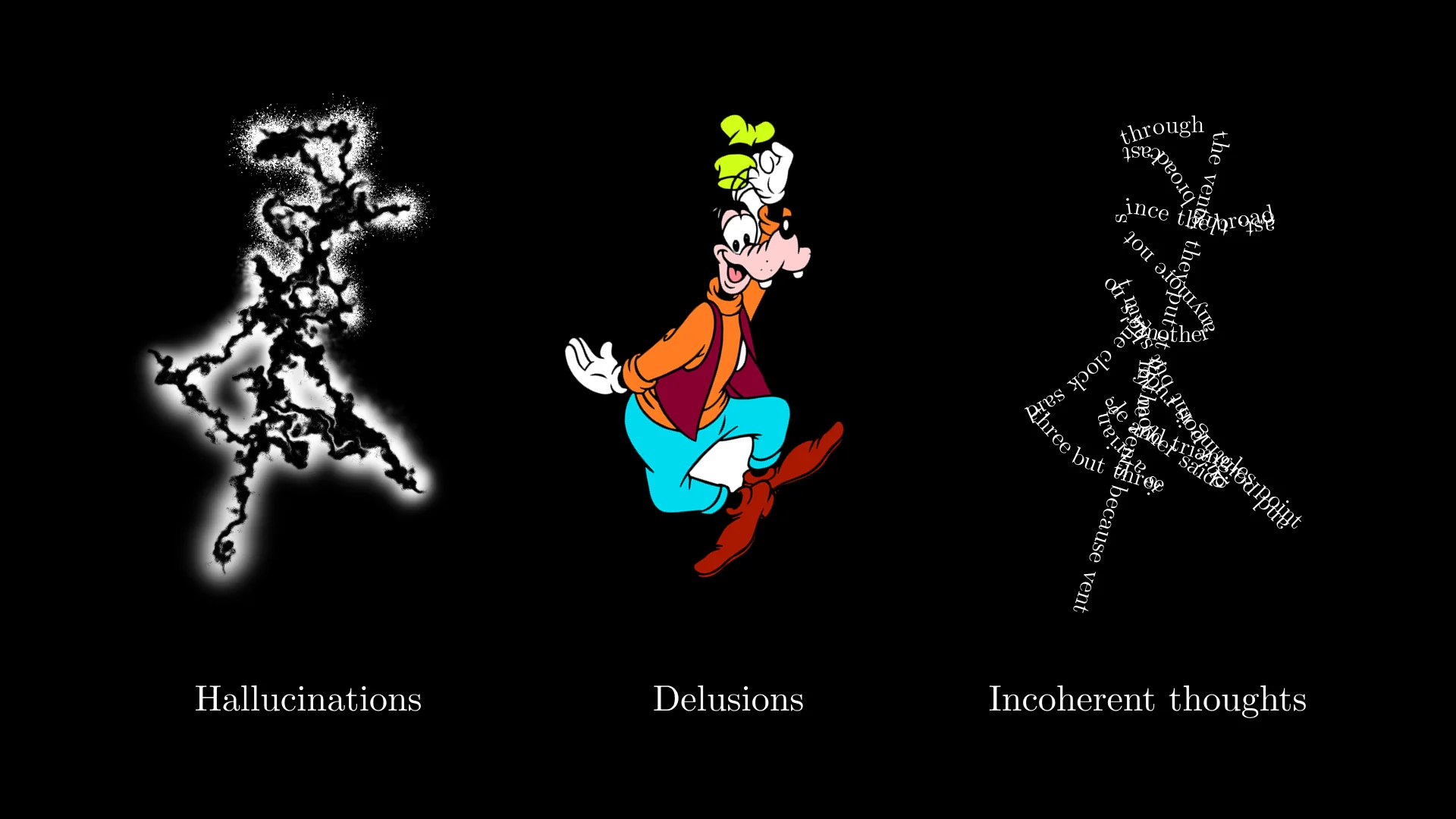
More specifically, psychosis can refer to three different psychiatric symptoms: hallucinations, delusions, and incoherent thoughts.
Underpinning these symptoms is a wide range of diagnosable conditions. The DSM-5 chapter on "Schizophrenia Spectrum and Other Psychotic Disorders" recognizes over a dozen, running from schizophrenia, to briefer and narrower diagnoses like brief psychotic disorder and delusional disorder, to psychosis induced by substances, medications, or other medical conditions. Of these, delusional disorder – one or more delusions persisting for at least a month, without the other prominent psychotic symptoms – is likely the most relevant to AI-associated cases. Clinicians further assess illness along a continuum that runs from at-risk-but-asymptomatic through prodromal, first-episode, recurrent, and chronic.
The most helpful lens I came across for understanding AI psychosis as a clinical phenomenon was the 'functional typology' proposed by Flathers, Roux, and Torous in The Lancet Digital Health. Rather than treating AI psychosis as one monolithic thing, their framework classifies cases by the functional role the chatbot plays in the psychotic episode: a catalyst precipitating new symptoms in previously healthy users, an amplifier worsening pre-existing or prodromal symptoms, a co-author iteratively developing harmful narratives with the user, or an object that becomes the very focus of the delusion.
The goal of introducing all these substitute terms and frameworks is not to drown a monolith in a semantic swamp, but merely to say: if you or someone you know might actually be undergoing 'AI psychosis,' underpinning this catch-all is probably a more precise symptom, condition, or psychological state – one that can help them, or a medical professional, better diagnose and treat what they're experiencing. There are genuinely surreal, and in some scenarios even comedic, aspects to what we might call AI psychosis, and we'll get to those. But before we do, it's important to confront the necessarily serious nature of the term and the phenomenon.
Now, to begin to understand how AI psychosis came to not necessarily mean clinical psychosis, let's build a rough etymology of the term.
There is a prehistory of AI psychosis that runs back through the earliest chatbots. Users of ELIZA, a 1960s pattern-matching script, famously attributed real understanding to it. More recently, we see precedents to AI psychosis in social-media-fueled delusions like the Slender Man stabbing. But for all intents and purposes, we can understand AI psychosis as a concept that begins with the launch of ChatGPT in late 2022, when large swaths of the public began using increasingly sophisticated general-purpose LLMs for the first time.
A year later, a Danish professor named Søren Østergaard published a journal article in Schizophrenia Bulletin prophesying chatbot-induced psychosis. Østergaard often gets retroactively credited as one of the first to discretely call out the phenomenon, but it would be a while yet before the literal term "AI psychosis" crystallized.
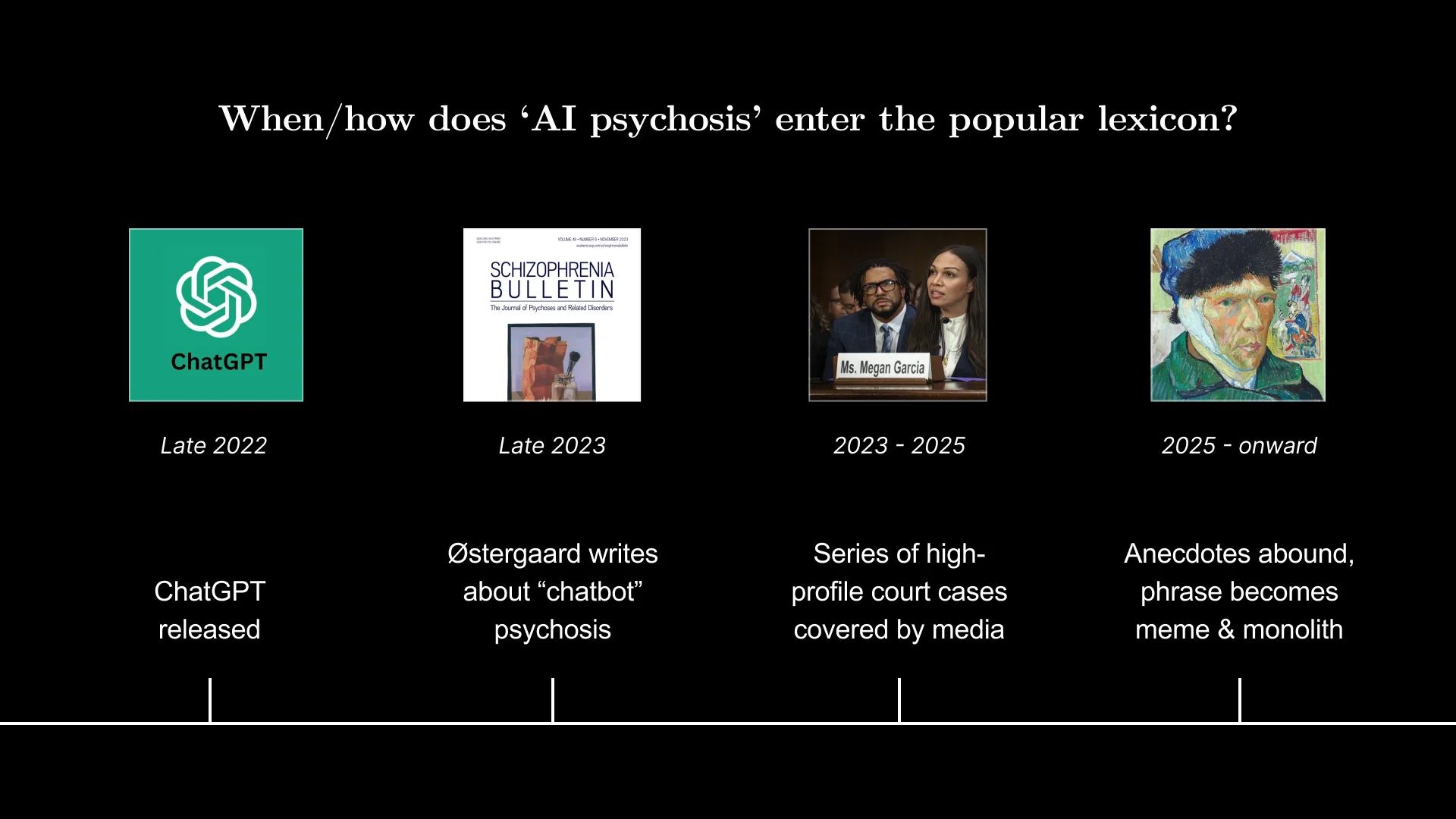
In the years that followed, LLM use exploded – and with it came a string of tragedies in which chatbots were alleged to have played a role in some users' suicides. As these cases went to court, their trials generated wide media coverage. By 2025, the combination of the lawsuits and a popular discourse around the uncanny experience of using sycophantic LLMs like GPT-4o finally gave way to the first uses of the term "AI psychosis." Appropriately, no single person or outlet is credited with originating it.
For those interested in a more detailed picture of the prehistory and history of 'AI psychosis,' I vibecoded this timeline:
Once the term became salient, it was widely recited as an explanation for a whole gamut of experiences, including ones not anchored in any traditional psychiatric category.
With this more casual usage, 'AI psychosis' also began to circulate as a tongue-in-cheek meme. Whether emerging from the degenerate behavior of a gold-rush environment, the broad anxieties about AI's impact across society, the destabilized sense of reality that synthetic media produces, or irony-poisoned technological accelerationism – people reached for the term as an intentionally crude label that could feign agency over a disempowering socio-technological shift. As with all memes, slap a label on something and it becomes less scary.
A question remains unanswered by our spectrum of definitions: what's the point? Even in its most serious manifestation, is AI psychosis something to care about? Or is it simply the newest media-generated moral panic?
If the AI Psychosis Summit was any illustration of broader sentiment, people seem wholly unsure what the net cost-benefit calculation of chatbots looks like. Surely the positive cases outnumber the negative ones. And surely psychosis-inducing behavior can be trained away? But is there a stickier philosophical problem lurking beneath a post-training problem – namely, that users of LLMs want models that tell them nice, encouraging things, that don't say no to them the way a human would, and that this artificial agreeableness might carry the unavoidable side effect of inspiring delusion? As an illustration, when OpenAI briefly retired GPT-4o – the model most associated with sycophancy – the user backlash was so intense that the company restored it within a day.
If recent history serves as any precedent, AI psychosis's most acute cases look reasonably preventable. Researchers have begun converging on concrete safeguards such as those proposed in a 2026 World Psychiatry paper by Keshavan and colleagues. They include psycholinguistic filters that detect prolonged circular dialogue, refusal of delusional roleplay, and automatic hand-off pathways to human clinicians when risk thresholds are met. Regulators are enforcing safeguards. California now requires chatbots to periodically remind heavy users to take breaks, and the EU's AI Act will soon mandate disclosures that users are talking to a machine.
Perhaps the more sinister thing, then, is not the acute, gut-wrenching cases of a more literal AI psychosis but, ironically, the fuzzy cultural definition – AI psychosis inasmuch as it means having an unhealthy relationship to AI, including cognitive surrender, diminished analytical skills, and dwindling reading comprehension. Perhaps it's in the shakiest definitions of AI psychosis that we actually find pressing pleas for new labels.
I intend to host more events like the AI Psychosis Salon – semi-casual seminar discussions that approach contemporary questions of technology through an interdisciplinary lens. If you have a suggestion for a topic, or you're interested in joining or supporting future events, please reach out.